The emerging physical learning-hub model in K12 / Analysis
What If Your Child’s Next School Isn’t a School?
Online lessons can teach. Sports academies can train. Examination boards can certify. The missing layer may be a small physical hub that gives children a dependable day, a peer group and one organisation accountable for making all those pieces work together.
What if a child does not need one institution to do everything a school currently does?
Imagine a teenager who learns mathematics online, trains seriously for football in the afternoon, sits Cambridge or NIOS examinations through the appropriate route, uses an external lab when needed—and still has somewhere physical to go every day.
A small learning hub.
A consistent group of peers.
Teachers and mentors who know the child.
A timetable somebody else is responsible for making work.
That sounds less like a conventional school.
But it may solve one of the biggest problems with flexible schooling.
The child may want flexibility. The parent still needs somebody to take responsibility for the day.
That is the business opportunity I find interesting.
Online learning solves instruction. It does not organise childhood.
A family can already buy many pieces separately.
Academic instruction can come from an online provider.
Sport can come from an academy.
Music from a specialist teacher.
Examinations from an established qualification pathway.
Libraries, labs and activities can be accessed elsewhere.
But somebody still has to answer:
What happens at 9:30 tomorrow morning?
Who notices that the child has stopped submitting work?
Who coordinates six subjects?
Who makes sure there are friends to meet?
Who speaks to the parent when something is not working?
Who helps the child move from Grade 8 to Grade 9, or from a qualification to university?
A conventional school bundles all of this.
The alternative model would unbundle the services but rebundle the responsibility.
That distinction matters.
We can already see versions of this in India
Beyond 8 is the closest documented example I found.
It describes itself not as a recognised school but as a Grades 9–12 learning programme, delivered through small pods in Chennai and Bengaluru. Learners follow Cambridge or NIOS pathways alongside mentoring, personalised timetables, projects and internships.[1]
Its January 2026 parent-consent document says programme fees are collected by Vidyothsahi Educational Services Private Limited.[2]
That tells us two things.
First, a company can participate in delivering and charging for this kind of learning programme.
Second, the provider itself distinguishes the learning experience from the qualification pathway.
That is exactly the architecture I am interested in.
Dreamtime Learning Hub gives us another useful signal.
In an April 2026 interview, management reported about 120 students in its Hyderabad hub and 200 in Pune, with annual microschool fees of roughly ₹2–5 lakh. It separately reported about 2,000 online-school students paying ₹60,000–80,000 annually.[3]
Those are management-reported figures, not audited enrolment.
But they show something important: some Indian families are already paying meaningful fees for a smaller physical learning environment.
Why would a parent choose this?
Not because an entire generation suddenly hates schools.
I do not think the evidence supports that.
The more useful way to think about demand is by family problem.
A serious athlete may need a timetable that bends around training.
A family already homeschooling may want the child out of the house for part of the week.
A teenager may be doing poorly in a large standardised classroom.
A parent paying premium-school fees may feel that the experience is not sufficiently personalised.
In each case, the value proposition is different.
But there is one common thread:
the family wants flexibility without becoming the school administrator.
That is why the physical hub matters.
The online curriculum alone is not enough.
The room, the adults, the peer group and the accountability are part of the product.
The child’s perspective matters too.
A model that works for the parent but feels lonely, unstable or boring to the teenager will not retain families for long.
There is some evidence for the underlying preference
A 2025 EdChoice survey of 170 US parents already using KaiPod-network microschools found that 60% cited flexible scheduling and 49% cited small class sizes as reasons for choosing the model. Seventy-six per cent said they were very satisfied and another 17% somewhat satisfied.[4]
But the limitation is important.
This was a survey of existing US microschool users, conducted with the provider network.
It does not tell us how many Indian parents would switch.
It does not prove better learning.
And it certainly does not establish a market size for India.
It simply supports the idea that flexibility, small groups and dependable support can be valuable to some families.
What exactly would the enterprise sell?
This is where I think the model becomes commercially interesting.
The enterprise does not necessarily have to own every component.
It could coordinate:
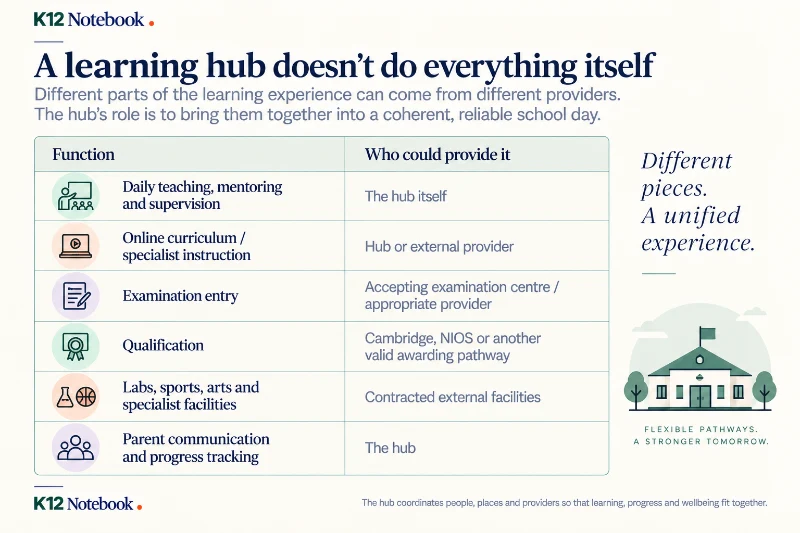
The value is not merely aggregation.
It is accountable delivery.
If football training gets cancelled, somebody fixes the timetable.
If the online provider is weak in physics, somebody finds support.
If a child is falling behind, somebody notices.
Parents may pay because they are buying a coherent educational day rather than six separate vendors.
The arithmetic can work—but only if the service is valuable
Take an illustrative hub with 100 learners paying ₹4 lakh a year.
That is ₹4 crore of annual programme revenue.
Ten hubs would be ₹40 crore.
Twenty-five would be ₹100 crore.
Those are not market-size estimates or profit forecasts.
They are simply a way to see why this could become a meaningful commercial learning-services business.
The cost side would still include:
- teachers and mentors
- premises
- academic-provider costs
- examination arrangements
- external labs, sport and activities
- administration and parent support
- student acquisition
- quality control.
A small hub also loses some of the economies a conventional school gets from scale.
Ten students choosing ten different subjects can become expensive very quickly.
Shared facilities may reduce capex.
They can also increase coordination cost.
So the economics depend heavily on local student density and subject combinations.
There is one major legal question we should not hand-wave
Can this simply be called a “learning centre” or “coaching centre” and therefore avoid school regulation?
I would not assume so.
Cambridge permits private candidates to enter exams through an accepting centre or approved examination provider. That provides access to the qualification.[5]
It does not automatically authorise the local learning hub itself.
CBSE, by contrast, has explicit rules for affiliated schools, including eligible managing entities and operation without a profit motive.[6]
And under the Right to Education Act, Sections 18–19 impose recognition and prescribed norms for schools providing elementary education. That makes Classes 6–8 particularly important for any Indian model.[7]
So a Classes 6–12 hub needs a state-specific legal analysis of what it is actually doing.
The words “commercial premises”, “coaching centre” or “learning hub” do not settle the classification.
That legal architecture is part of the business model, not a footnote.
The strongest objection is the conventional school itself
A good school already solves the coordination problem.
One campus.
One timetable.
Friends.
Teams.
Labs.
Teachers.
Counsellors.
A principal.
Parents know who is responsible.
A learning hub therefore has to be meaningfully better for a specific family.
More flexible.
More personalised.
More compatible with sport, music or another pursuit.
More supportive than homeschooling alone.
And reliable enough that the parent does not end up doing the coordination anyway.
That is a high bar.
So is this the next school model?
Maybe for some families.
I do not think the evidence supports saying it will replace schools.
Nor that it will automatically be cheaper.
Nor that it produces better outcomes.
But I do think a real business can exist around this gap:
a premium K12 enterprise that does not own every component of schooling, but takes responsibility for making the child’s learning day coherent.
The conventional school bundles everything inside one institution.
The learning hub could bundle accountability while sourcing different pieces from different places.
That may be the more important innovation.
Because parents do not actually buy a curriculum.
They buy confidence that someone competent is making the whole thing work.
Show the working
Sources & calculations
Research checked 2026-10-07. Publication dates and reporting periods are listed separately.
- Beyond 8 — Frequently Asked Questions ↗Beyond 8 · Current webpage
Beyond 8 describes itself as a Grades 9–12 learning programme delivered through small pods in Chennai and Bengaluru, using Cambridge or NIOS pathways with mentoring, personalised timetables, projects and internships.
Limit: Provider description; does not establish profitability, regulatory status of a new operator or superior learning outcomes. - Beyond 8 Parent & Guardian Consent ↗Beyond 8 / Vidyothsahi Educational Services Private Limited · 2026-01-06
States that Beyond 8 programme fees are collected by Vidyothsahi Educational Services Private Limited and that learners pursue Cambridge or NIOS examination pathways.
Limit: Establishes company participation and fee collection, not a blanket legal model for alternative schooling. - Backed by Nikhil Kamath, Lina Ashar’s Dreamtime Learning is reimagining K-12 education ↗YourStory · 2026-04-13
Management-reported Hyderabad hub ~120 students, Pune centre 200 students, microschool fees ₹2–5 lakh annually, ~2,000 online students and ₹60,000–80,000 online fees.
Limit: Management-reported figures in an interview; not audited enrolment or proof of demand for a specific Classes 6–12 Cambridge hub. - KaiPod Survey Results: Inside the Microschool Movement ↗EdChoice / KaiPod Learning · 2025-08
Survey of 170 current KaiPod-network microschool parents: flexible scheduling 60%, small class sizes 49%, very satisfied 76%, somewhat satisfied 17%, part-time attendance 77%, previously homeschooled 48%.
Limit: US survey of existing users conducted with the provider network; not representative of Indian parents and not evidence of superior learning outcomes. - How to register as a private candidate ↗Cambridge International Education · Current webpage
Private candidates can enter Cambridge exams through a centre or approved Cambridge exam provider that accepts private candidates.
Limit: Qualification access does not authorise a local learning hub or override Indian operating/recognition requirements; some syllabuses/options are unavailable to private candidates. - CBSE Affiliation Bye-Laws ↗Central Board of Secondary Education · 2018
CBSE rules prescribe recognised managing entities and require affiliated schools to be run as community service without commercialisation/profit motive.
Limit: Applies to CBSE-affiliated schools and should not be generalised into a rule that every educational activity in India must be nonprofit. - Right of Children to Free and Compulsory Education Act, 2009 ↗Government of India / India Code · 2009
Sections 18–19 require recognition and prescribed norms for schools providing elementary education, making operating classification especially important for Classes 6–8.
Limit: Application to a specific learning-hub structure depends on its actual activities and the relevant state rules; article does not give legal advice.
What this does not establish: The model is a hypothesis, not an established market category. Provider enrolment and fee figures are self-reported where noted. US microschool survey evidence does not establish Indian demand. Qualification access through Cambridge private candidature does not authorise a hub. Classes 6–8 require particular care because RTE recognition/norm requirements may apply depending on classification and state rules. The article does not conclude that the model is cheaper, better academically or a substitute for conventional schools.